Reachy Mini Goes Fully Local: Why On-Device AI Is the Next Big Shift
For the last few years, almost every intelligent thing you have used has been living somewhere else. Your phone, your laptop, even your smart speaker have been thin clients, sending your words, your voice, and your questions across the internet to powerful computers in data centers, then waiting for the answer to come back.
That model just took a serious hit. Reachy Mini now runs fully local. The robot does its thinking on its own hardware, with no cloud round trip required. It is a small change on a spec sheet and a giant change in direction for the entire AI industry.
Here is why this matters, what it signals about where AI is heading, and what businesses should actually do about it.
What "Fully Local" Actually Means
When a system goes fully local, the entire loop stays inside the device. The robot sees, hears, decides, and responds, all on the hardware sitting in front of you. Nothing has to be packaged up, shipped to a server, processed, and sent back.
That is a real break from how most AI products are built today. The standard pattern is a hybrid: a tiny bit of processing happens on the device, and the heavy lifting happens in the cloud. The device is basically a microphone with a screen. The brain is a thousand miles away.
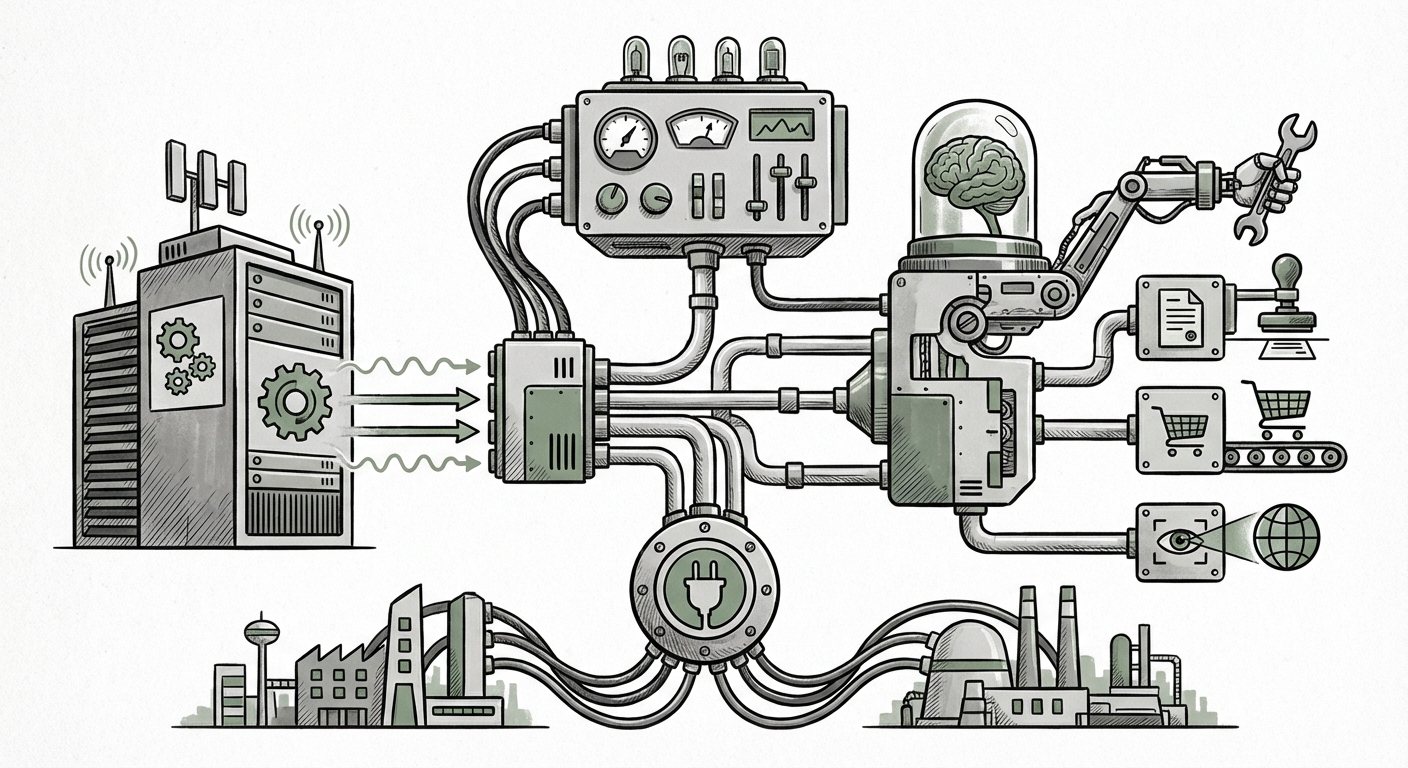
Going fully local flips that. The brain moves in. And once the brain is in the room with you, a lot of things change at once, privacy, speed, cost, and reliability all get re-sorted.
The Cloud Was Never the Goal, It Was a Workaround
It helps to remember why AI ended up in the cloud in the first place. It was not because the cloud was better. It was because the models were heavy and the chips on our desks were not strong enough to run them.
That gap has been closing fast. AI models have become dramatically more efficient. Researchers have learned how to shrink models without gutting their usefulness. Chips designed specifically for AI work have moved from data centers into laptops, phones, and now robots.
The result is a quiet reversal. Tasks that absolutely required a server three years ago now run comfortably on a device that fits on a desk. Reachy Mini going fully local is not an oddity, it is a preview of the default.
Privacy Becomes a Feature, Not a Footnote
Think about what a robot with cameras and microphones actually sees and hears. Faces. Voices. Conversations. Your office whiteboard. Your living room.
In a cloud-based setup, every one of those moments has to travel across the internet to be understood. Even with strong encryption and good intentions, that is a long list of places where sensitive data can be exposed, misused, or simply stored longer than anyone wanted.
Fully local AI changes the answer to the scariest question a buyer can ask: "Where does my data go?" The answer becomes simple, nowhere. It stays on the device.
That is not just a nice talking point. It is becoming a purchasing requirement. Schools, hospitals, law firms, factories, and government offices are all under pressure to stop shipping sensitive audio and video into third-party systems. A device that never sends anything out clears that hurdle on day one.
Speed, Cost, and the Economics of Always-On AI
Latency sounds like a technical detail until you watch a robot try to react to the world. A pause of half a second is fine when you are chatting with a chatbot. It is not fine when a machine needs to notice someone stepping into its path.
Local processing removes the network from the equation. Responses happen in the time it takes the chip to think, not the time it takes the internet to deliver.
The money math is just as blunt. Cloud AI is usually priced per request, per token, or per minute. Those costs scale with usage, and always-on devices use a lot. A robot that is listening, watching, and reasoning all day is a robot that is generating a bill all day.
Local AI converts that ongoing expense into a one-time hardware cost. You buy the capability instead of renting it. For any product that is meant to run continuously, that is a fundamentally better business model.
What This Means for the Future of AI
The most likely future is not "cloud AI dies." It is a split.
- Frontier tasks stay in the cloud. The biggest, most demanding reasoning jobs will keep running on massive clusters, because that is where they belong.
- Everyday tasks move to the device. Understanding speech, recognizing objects, following a face, answering a simple question, controlling movement, these will increasingly happen locally.
- Robots and embodied AI lead the charge. Anything that moves through the physical world needs instant reactions, works in places with bad Wi-Fi, and carries a camera. All three push hard toward local processing.
This split has a second effect that gets less attention: it breaks the tight link between using AI and being connected to a specific vendor's servers. When the intelligence lives on hardware you own, you are less dependent on someone else's uptime, pricing changes, or policy decisions.
Practical Implications for Businesses
Product teams
If you are building anything with a sensor and a screen, assume local processing is on the roadmap. Design as if the network might not be there, because for many customers, in many buildings, it is not. Products that work offline will feel more reliable than products that do not.
Security and IT teams
Local AI removes a whole category of risk from your vendor review list. At the same time, it adds a new one: the device itself now holds sensitive data. Physical security, device encryption, and a clear plan for wiping hardware at end of life become the new checklist items.
Operations and cost planning
Start modeling AI as a capital expense instead of a subscription. For high-usage deployments, the shift can be dramatic. Ask vendors directly how their pricing changes when processing moves on-device.
Customer trust
"Your data never leaves this device" is one of the strongest sentences a sales team can say. If you can make that claim honestly, put it on the box.
The Hard Parts Nobody Should Ignore
Local AI is not free of tradeoffs, and pretending otherwise leads to bad decisions.
- Smaller models are less capable. A local model will not match the biggest cloud systems on complex reasoning. The skill is knowing which jobs actually need that extra power.
- Updates get harder. Cloud models improve silently overnight. Local models need a patching and update process you have to build and maintain.
- Hardware becomes the ceiling. You cannot outrun the chip you shipped with. That raises the stakes on choosing good hardware up front.
- Safety still applies. A robot that acts instantly and independently needs strong guardrails, because there is no server-side filter catching mistakes in the middle.
How to Prepare: Actionable Steps
- Audit your AI tasks. Sort every use case into "needs frontier power" and "needs to be instant, private, and cheap." Most teams find the second list is much longer than they expected.
- Ask vendors where processing happens. "Cloud, local, or hybrid?" should be a standard question in every AI purchase, right next to price and support.
- Test offline. Turn off the Wi-Fi and see what still works. That single test reveals how much of your AI stack is actually yours.
- Plan for device lifecycle. If intelligence lives on hardware, hardware refresh cycles become AI refresh cycles. Budget for them.
- Update your privacy language. If your data handling improves, say so plainly. Trust is easier to win than to rebuild.
The Bottom Line
Reachy Mini running fully local is a small headline that points at a very large trend. For a decade, AI got smarter by getting bigger and further away. Now it is getting useful by getting smaller and closer.
That shift will reshape which devices can be intelligent, which companies get to sell them, and how much of our daily life gets routed through someone else's servers. The winners will be the teams that stop assuming the cloud is the only place intelligence can live, and start building for a world where the brain is in the room.