Production MLOps Without the Code: What GS Caltex's SageMaker Canvas Rollout Means for Enterprise AI
For years, the story of enterprise AI has been stuck on repeat. A company runs a promising pilot. The model works in a notebook. Then the hard part begins, data pipelines, versioning, monitoring, retraining, permissions, approvals, and the project quietly dies before it ever touches a real decision.
That gap between a demo and a deployed system is where most AI value gets lost. So when a large industrial company announces it is running production MLOps on top of a no-code tool like Amazon SageMaker Canvas, it is worth paying attention. GS Caltex, a major energy and petrochemical company, is documenting exactly that: taking visual, low-code machine learning models and putting them into real production use. The write-up is labeled "part 1," which tells us something too, this is a journey being shared step by step, not a victory lap.
The headline is not really about one tool. It is about a shift in how AI gets built, who builds it, and what "done" means.
The Shift: From Notebooks to Factory Floors
Machine learning operations, MLOps, is the unglamorous discipline that keeps AI alive after launch. It covers how models are trained, tested, deployed, monitored, and updated. Without it, a model is a science fair project. With it, a model becomes infrastructure.
What makes the GS Caltex approach notable is the combination. On one side you have SageMaker Canvas, a tool built for people who are not professional coders. It lets analysts point at data, pick a target, and train models through a visual interface. On the other side you have production MLOps, the rigorous end of the spectrum, the part that involves repeatable workflows, tracking, and operational discipline.
Historically these two things lived in different buildings. Low-code tools were seen as sandboxes for beginners. Production systems were built by specialized engineering teams. Bringing them together changes the math on how many AI projects a company can actually run.
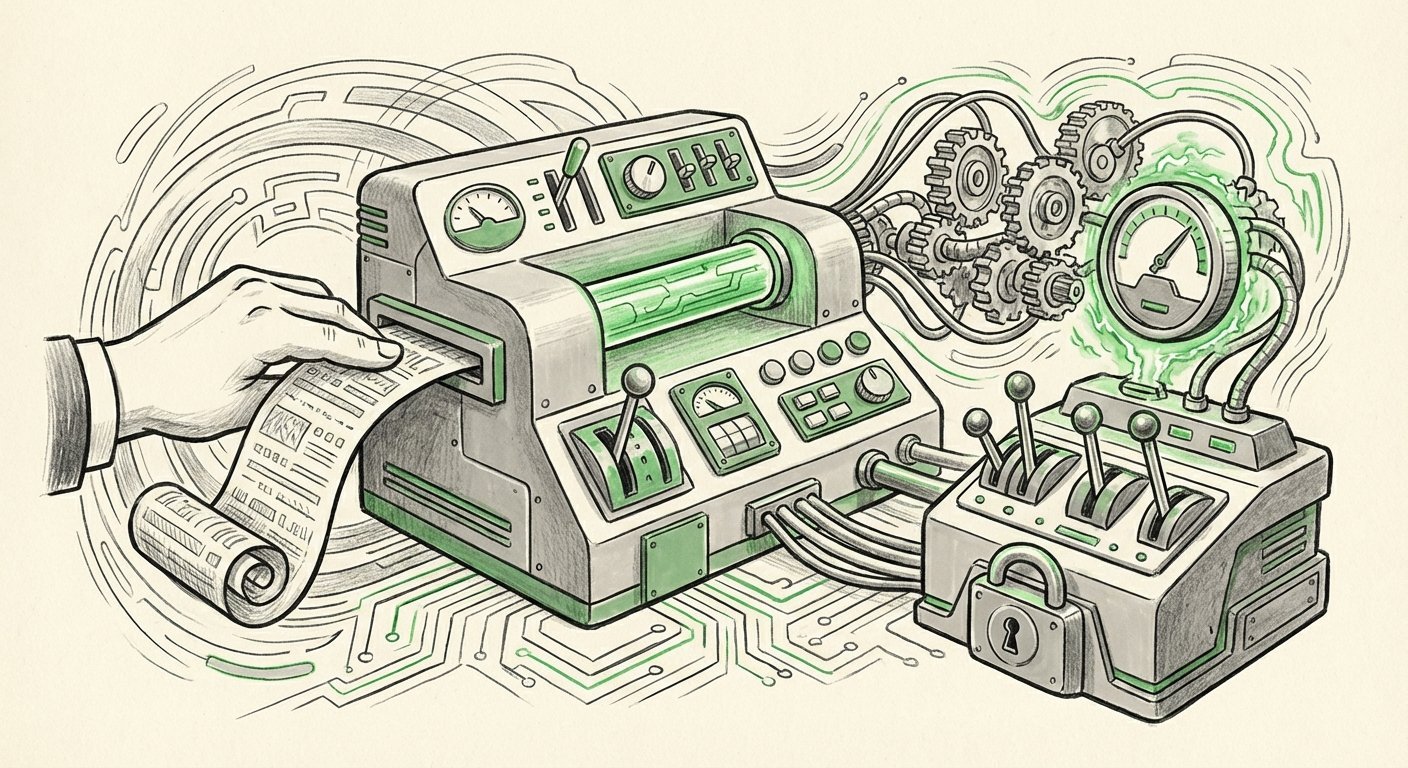
Think of it like manufacturing. A single master craftsman can build a beautiful prototype by hand, but you cannot supply a market that way. You need a production line that lets many trained workers build many reliable units. No-code ML plus real MLOps is the beginning of an AI production line, one where domain experts, not just data scientists, can contribute working models.
Why an Energy Company Is the Perfect Test Case
Refining and petrochemical operations are dense with the exact problems machine learning is good at: predicting equipment behavior, forecasting demand, spotting quality drift, optimizing energy use, and flagging anomalies before they become outages. These are also problems where the people who understand the physics are rarely the people who understand Python.
That mismatch has been a quiet tax on industrial AI. A process engineer with twenty years of plant experience can see a pattern in sensor data almost instinctively, but cannot build a model. A data scientist can build a model but may not know which variables actually matter in a given unit. Every project becomes a translation exercise, and translation is slow.
If an analyst on the plant floor can build and validate a model in a visual environment, and then hand it into a governed production pipeline, that translation cost drops sharply. The bottleneck moves from "can we build it?" to "should we build it?" That is a much healthier place to be.
What "Production" Actually Requires
It is easy to say a model is in production. It is harder to make that true. Real production MLOps depends on a handful of things that a no-code interface alone cannot give you:
- Repeatability. The same inputs must produce the same model, every time. A process that only works when one person clicks through it by memory is not a process.
- Lineage and tracking. Teams need to know which data trained which model, when, and with what settings. When a number looks wrong six months later, that record is the difference between a fix and a mystery.
- Monitoring and drift detection. The world changes. Models quietly degrade. Production means someone gets alerted before the business notices the damage.
- Retraining loops. Models need to be refreshed on a schedule or a trigger, not whenever someone remembers.
- Governance and access control. Who can publish a model? Who can approve it? What data is allowed in? These questions get sharper, not softer, as more people gain the ability to build.
The interesting engineering story here is not the model itself. It is the connective tissue, the bridges that let citizen-built models pass through the same safety checks as expert-built ones. That is the part most organizations underestimate, and the part that determines whether a no-code program scales or stalls.
The "Part 1" Signal
There is a small but meaningful detail in the framing: this is part one. That suggests a multi-stage account, likely covering foundations first, with more to come on operations, scaling, and lessons learned.
That structure is honest, and it is a useful model for other companies. MLOps maturity rarely arrives in a single release. It usually looks like this: get one model into production properly, learn what breaks, harden the pipeline, then widen access. Publishing it in stages reinforces a truth the industry needs to hear more often, there is no finish line. The companies that succeed at AI are not the ones with the best first model. They are the ones with the best tenth model, built faster and safer than the first.
What This Means for the Future of AI
Three bigger trends sit underneath this story.
1. The citizen data scientist becomes real infrastructure
For a decade, "citizen data scientist" was mostly a marketing phrase. The tools were too shallow for real problems and too disconnected from deployment to matter. As low-code ML gets wired into genuine MLOps pipelines, the phrase starts to mean something. Domain experts become model builders, and the data science team shifts from building every model to building the guardrails, platforms, and standards that let others build safely.
That is a staffing model change, not just a tooling change. It means fewer bottlenecks, faster iteration, and a different job description for the central AI team.
2. Industrial AI is where the next wave of value lands
Consumer AI gets the headlines. Industrial AI gets the savings. Energy, chemicals, manufacturing, and logistics run on physical processes full of measurable variables, which is exactly the environment where predictive models pay off quickly and measurably. Expect more of the AI budget to move toward operations, maintenance, and supply chain, and away from novelty experiments.
3. Governance becomes the differentiator
When more people can build models, the risk surface grows. A company that lets hundreds of employees train models without tracking, approval, and monitoring is not democratizing AI, it is accumulating technical debt with a confidence problem attached. The winners will be organizations that pair openness with strong, mostly invisible guardrails. Frictionless for the builder, rigorous underneath.
Practical Lessons for Business Leaders
If you are trying to move AI from pilot purgatory into daily operations, this example offers a workable pattern.
- Pick one real problem, not a showcase. Choose something with a measurable business number attached, downtime hours, energy spend, scrap rate. Pilots built for demos rarely survive contact with operations.
- Build the pipeline before you widen access. Get monitoring, versioning, and retraining working on a single model first. Then invite more builders in.
- Put domain experts in the driver's seat. The person who knows why a compressor behaves oddly is more valuable in the modeling loop than another engineer who can tune hyperparameters.
- Treat the platform team as an enabler, not a gatekeeper. Their job is to make the safe path the easy path.
- Measure time-to-production, not model accuracy alone. A slightly less accurate model that ships in three weeks beats a perfect model that ships never.
- Plan for decay on day one. Every model you deploy will need refreshing. If retraining is an afterthought, your production system has an expiry date.
The Honest Caveats
No-code ML is not a replacement for deep expertise. Complex problems, custom architectures, unusual data types, tight latency requirements, still need skilled engineers. Visual tools also make it easy to build many models quickly, which can produce a sprawl of unmanaged artifacts if governance lags behind enthusiasm.
The real lesson from a production rollout like this one is balance. Widen who can participate, but tighten how things get shipped. Speed on the front end, discipline on the back end.
The Bottom Line
The most important thing about a major industrial company running production MLOps on a visual ML platform is not the technology. It is the proof point. It shows that the gap between "an analyst had an idea" and "a model is making decisions in the business" can be closed, repeatably, and with oversight.
That is what the next phase of enterprise AI looks like. Fewer moonshots, more production lines. Fewer data science heroes, more trained operators. Fewer dashboards about what happened, more models quietly shaping what happens next. And as the "part 1" framing suggests, the story is only getting started.