JEPA-Anything: One AI Recipe, Seven Fields, Why World Models Just Got a Lot More General
For the past few years, the most impressive AI systems have all been specialists. One model writes code. Another model reads X-rays. A third one steers a robot arm. Each of them needed its own design, its own training data, and its own team of engineers to babysit it. That approach works, but it does not scale the way anyone wants it to.
Now comes JEPA-Anything, a piece of work that makes a much bigger claim than "we built a better model." The claim is about the recipe itself. One single approach, one shared way of teaching a machine how the world works, was applied successfully across seven different fields. Not seven variations. Not seven fine-tuned cousins. One recipe.
That is the kind of result that quietly reshapes an entire research agenda. And it raises a question every business leader should be asking right now: if one recipe can cover seven fields, what happens when it covers seventy?
World Models, Explained Without the Jargon
Almost all the AI you have heard about in the news is a generator. You give it text, it gives you more text. You give it a prompt, it draws a picture. These systems are built to produce things.
A world model is different. It does not try to produce a picture of what happens next. It tries to understand what happens next. It builds an internal sense of how things move, change, and respond, the way you already know that a dropped glass will fall and a pushed door will swing.
JEPA, short for Joint Embedding Predictive Architecture, is a family of designs for building those world models. Its key trick is where it does its thinking. Instead of predicting raw pixels or raw words, it predicts inside an abstract summary of the scene. Think of it like predicting the plot of a movie instead of rendering every frame. It is cheaper, it is more stable, and it forces the model to learn the structure of a situation rather than its surface details.
That idea has been one of the most influential directions in AI research for several years. What is new here is not the idea. It is the range.
The Old Playbook: One Custom Key for Every Lock
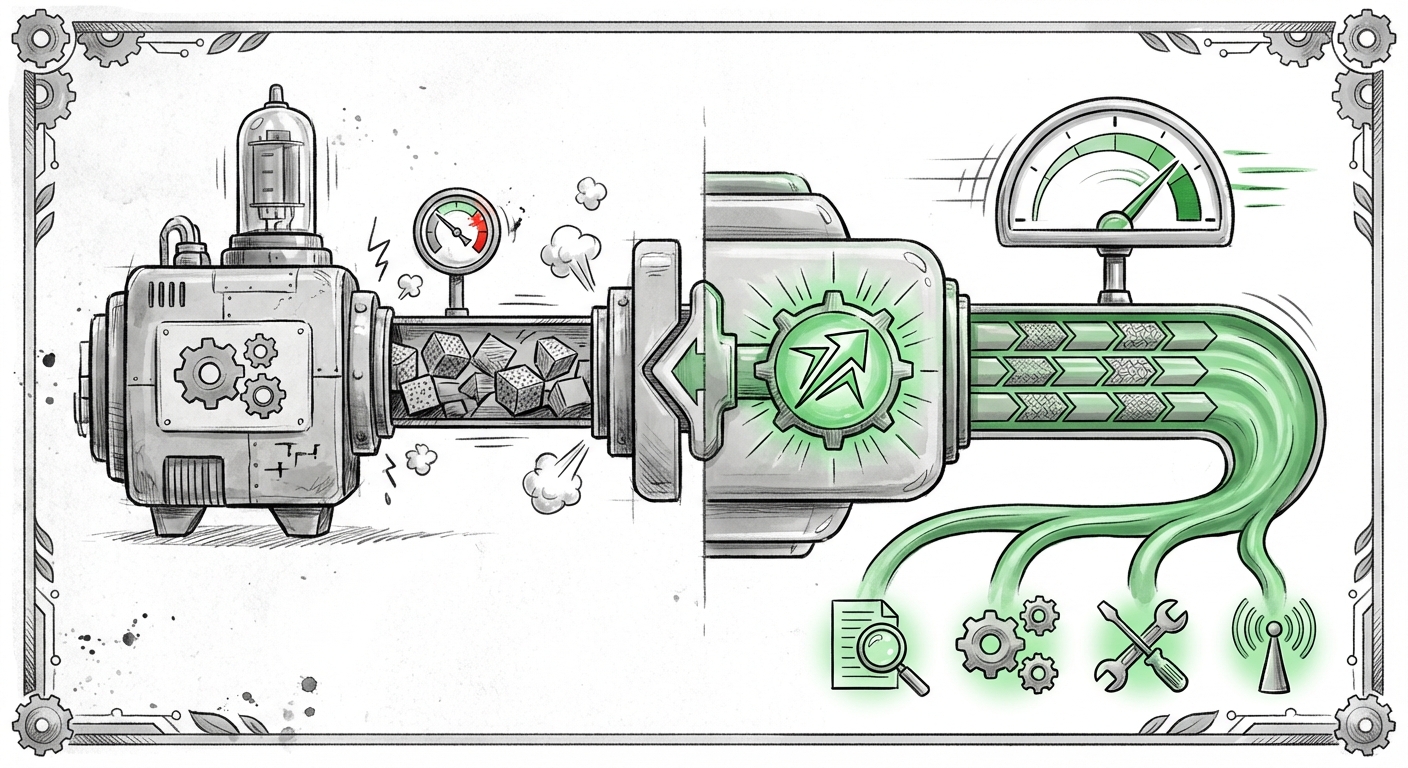
Traditional domain AI works like a locksmith who hand-cuts a new key for every door in the building. Vision gets one architecture. Robotics gets another. Scientific modeling gets a third. Each one requires its own data pipeline, its own tuning, its own failure modes, and its own maintenance crew.
This is expensive in a way that is easy to underestimate. The cost is not just the compute. It is the duplicated human effort. Every new field means starting the research clock over again. Progress in one area does not automatically help another. The whole system is fast at the beginning and painfully slow at the margins.
Generality is the fix. A general recipe means lessons learned in one field carry over to the next. It means a smaller team can cover more ground. It means the tenth application costs far less than the first one did.
What "One Recipe, Seven Fields" Actually Changes
The headline of JEPA-Anything is not a benchmark score. It is a pattern. The same core approach, with the same underlying logic, produced working world models in seven separate areas of application.
Why does that matter so much? Because in machine learning, generality is not just a nice bonus, it is evidence. When one method works in a single domain, you cannot tell whether you discovered a principle or just got lucky with a dataset. When the same method works in seven, the odds shift. You are probably looking at something real about how learning works, not a coincidence.
It also changes the economics of prediction. Once a foundation world model exists, a new domain becomes an adaptation problem rather than an invention problem. You start from a system that already understands physical cause and effect, and you teach it the specifics of your world. That is a fundamentally faster and cheaper job.
Why This Is a Turning Point, Not Just Another Release
There are three reasons this development lands differently than another model announcement.
1. The race shifts from scale to architecture
For a long stretch, the main lever in AI was "make it bigger." That lever still works, but it is brutally expensive and increasingly concentrated among a handful of players. A general architecture is a different kind of advantage: it makes everything downstream cheaper, including for organizations that will never train a frontier model from scratch.
2. World models become a platform, not a project
Specialist models are projects. They have a beginning, a build, and a maintenance burden. A general world model looks more like infrastructure, something you build on top of, the way companies build on top of cloud computing. That is the moment a technology stops being a research topic and starts being an industry.
3. Abstract prediction solves a real-world headache
Generating every detail is wasteful when you only need to know what happens next. For robots, factories, and logistics networks, the value is in the prediction, not the picture. Methods that reason in a compressed representation are a much better fit for these settings, where speed and reliability matter more than visual polish.
What This Means for Businesses Right Now
If generality holds up, the practical playbook changes. Here is what to do with it.
- Audit for prediction problems. Find the places where your business already depends on guessing what happens next, demand, equipment failure, machine wear, traffic, crop yields, patient outcomes, supply shocks. Those are world-model problems in disguise.
- Stop assuming you must build from zero. The old default was "we need a custom model." The new default is "we need to adapt a general one." That distinction can cut months off a timeline and millions off a budget.
- Treat your operational data as the moat. If the recipe becomes common, the differentiator becomes the world you teach it about. Companies sitting on years of messy, real-world operational data are holding something newly valuable.
- Run narrow pilots with clear success criteria. Pick one process, define what "better prediction" is worth in dollars, and measure it. General world models are still an emerging capability; a tight pilot protects you from a broad, vague rollout.
- Hire for representation thinking. The skills that matter here are not prompt writing. They are understanding how models compress, generalize, and fail, and knowing when a prediction can be trusted.
What It Means for Society
The upside is significant. Better world models make autonomous systems safer, because a machine that understands cause and effect is less likely to do something absurd. They make scientific modeling faster, which compounds into drug discovery, materials work, and climate analysis. They make advanced prediction available to organizations that could never have built it themselves, which is genuinely democratizing.
But the same generality that creates those gains also creates concentration. If one recipe becomes the standard, then whoever controls the best version of it sits underneath an enormous number of downstream products. That is a familiar pattern, and it deserves scrutiny before it hardens, not after.
There is a second, subtler risk: monoculture. If everyone builds on one shared architecture, everyone inherits the same blind spots. Diverse systems fail in different ways, which is a safety feature. Uniform systems fail together. Independent evaluation and real-world testing are not optional extras here, they are the price of adoption.
The Honest Limits
Seven fields is a strong result. It is not all fields. The domains that were tested are likely the ones where the method was expected to work. The test that matters now is the eighth, the tenth, and the hundredth, and whether the approach keeps working when the data gets messier, the stakes get higher, and the environment refuses to stay still.
It is also worth remembering that strong performance in a controlled study and reliable performance in a live factory or hospital are two different things. Generalization claims need replication by other teams, on other datasets, before they can be treated as settled.
What to Watch Next
Three signals will tell you whether this is a turning point or a data point.
First, replication. If independent groups get the same recipe working in their own fields, the generality claim solidifies. Second, scaling behavior. If the approach improves predictably as compute and data grow, it becomes a strategy, not a trick. Third, productization. When world models start showing up inside ordinary industrial software, quietly, without a launch event, the transition is already underway.
The deeper story here is not about one system. It is about a shift in what AI research is chasing. Instead of building a separate genius for every task, the field is asking whether there is a single, transferable understanding of how the world works, and whether one recipe can teach it. JEPA-Anything's seven fields are the strongest argument yet that the answer might be yes.
For businesses, the practical takeaway is to start looking at your operations through a prediction lens today, while the adaptation costs are still low and the field is still wide open. The organizations that move early on general world models will not just be faster. They will be working from a different map.