How Hugging Face Inference Endpoints, Jobs, and Buckets Power AI Search, And What It Means for the Future of AI
Search is changing fast. Not long ago, searching meant typing words into a box and getting a list of links back. Today, search means typing a question and getting an answer. That shift sounds simple. It is not. Behind every "smart" search box sits a pipeline of machines that store huge amounts of data, turn that data into numbers a computer can compare, and then serve results in the blink of an eye.
One of the clearest examples of this new kind of search is the work behind Papers with Code, a site that pairs research papers with the code that makes them run. Making that content easy to search, by meaning, not just by keyword, requires a full stack of AI infrastructure. The stack in question is built on three Hugging Face tools working together: Inference Endpoints, Jobs, and Buckets.
That combination is worth studying closely, because it is the same pattern thousands of companies will copy over the next few years. Understand these three pieces, and you understand where AI products are heading.
Why Search Became an AI Problem
Old-fashioned search matched words. If you searched for "image classification," you got pages that used those exact words. If you searched for "teaching computers to tell cats from dogs," you got nothing useful, even though the two ideas mean nearly the same thing.
Modern AI search fixes this by turning text into embeddings. An embedding is a long list of numbers that captures what a piece of text actually means. Two sentences with the same meaning end up with similar number lists, even if they share no words. Search then becomes a math problem: find the number lists closest to the one built from your query.
That sounds elegant. In practice, it creates three hard problems:
- You need a place to keep millions of embeddings. They are big, and they must be available at all times.
- You need heavy computing power to create them. Turning a whole library of papers into embeddings is a batch job, not something you do on a laptop.
- You need instant answers at query time. When a user types, a model must run immediately, no waiting, no cold starts, no crashes under load.
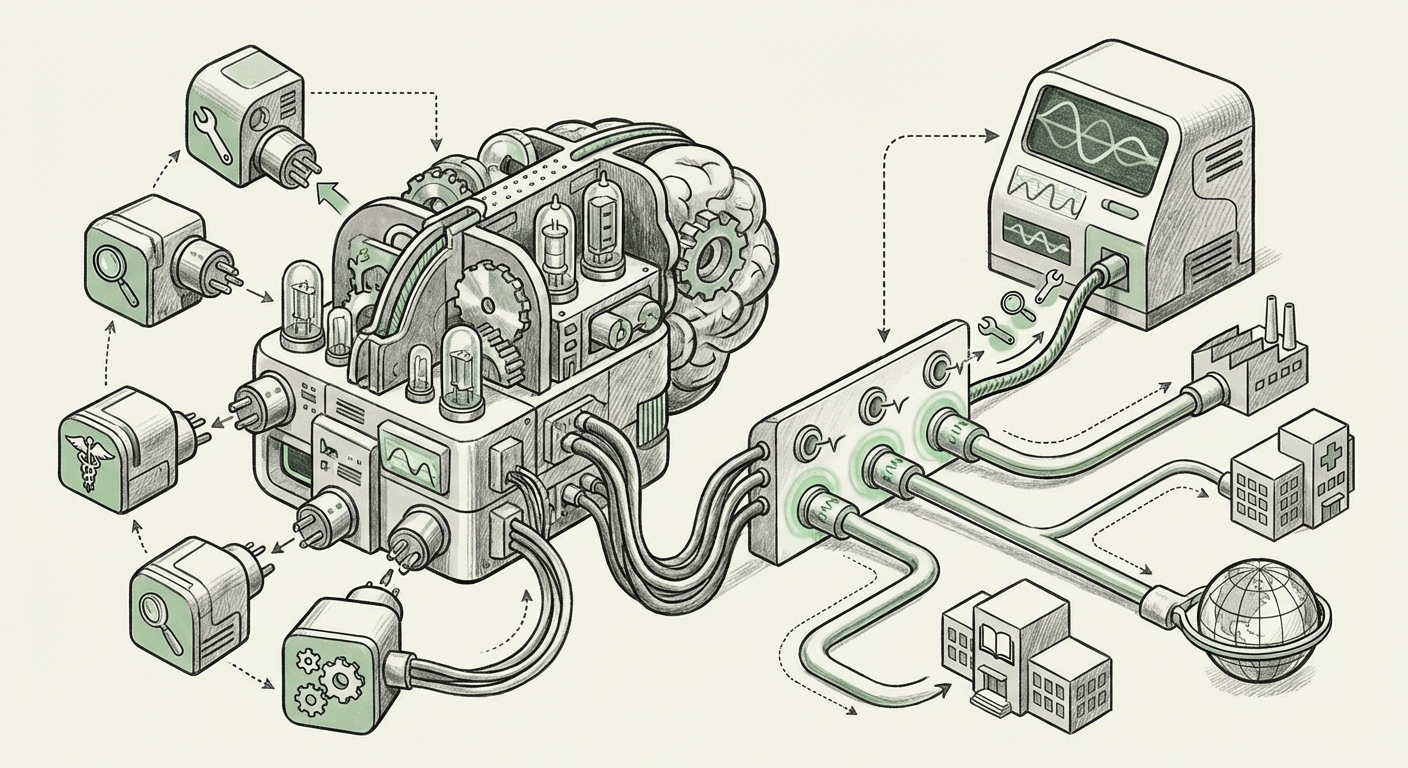
Those three problems map almost perfectly onto Buckets, Jobs, and Inference Endpoints.
The Three Building Blocks of AI Search
Buckets: The Long-Term Memory
Buckets are object storage, a place to park files. In an AI search system, they hold the raw material: documents, papers, metadata, and the embedding files built from them. Think of it as the system's long-term memory.
This layer matters more than people expect. A search index is not a one-time build. New papers arrive constantly. Papers get revised. Code repositories change. Without durable, cheap, always-available storage, the whole system drifts out of date within weeks.
Buckets also do something quietly important: they decouple storage from computing. The data lives on its own. The machines that use it can come and go. That separation is what makes the system affordable to run and easy to rebuild.
Jobs: The Factory Floor
Jobs are managed batches of compute. You hand over a task, like "generate embeddings for this new set of papers", and the platform runs it and shuts down when finished. You pay for the work, not for idle machines.
This is the factory floor of AI search. Nothing here is glamorous. It is a conveyor belt: pull raw text from storage, run it through an embedding model, write the results back to storage. But it is the step that keeps the index fresh, and freshness is the difference between a search engine people trust and one they abandon.
The pattern also matters economically. Embedding work is spiky. You might process a small daily trickle of new content, then a giant backfill when you add a new data source. Batch jobs absorb that spike without forcing you to keep a huge fleet of servers running year-round.
Inference Endpoints: The Front Door
Inference Endpoints are managed, always-on services that run models and return results on demand. This is the front door of the search system, the part users actually touch.
Every query triggers work here. The user's words are turned into an embedding, compared against the stored ones, and the best matches are returned. Sometimes a second model then reads those matches and writes a plain-language answer.
This is where reliability is won or lost. Users do not care that the index was built beautifully last month. They care that the answer arrived in under a second, on a phone, on a slow connection, at peak traffic. Endpoints exist to make that happen without a team of engineers babysitting servers.
Why This Architecture Is a Blueprint, Not a One-Off
What makes the Papers with Code setup notable is not any single tool. It is the shape of the stack: store once, process in batches, serve in real time.
That shape shows up everywhere now:
- A law firm building search across decades of case files.
- A hospital building search across clinical guidelines.
- A retailer building search across its product catalog.
- A software company letting customers search their own documentation.
None of these are research projects. They are ordinary business problems, and they all reduce to the same three questions: Where does the data live? How do I keep the index fresh? How do I answer queries fast?
The bigger trend here is the disappearance of the infrastructure excuse. A few years ago, building semantic search meant hiring a platform team. Today it means choosing a storage layer, a batch runner, and a serving layer. The barrier has moved from engineering to product thinking, deciding what is worth searching and what a good answer looks like.
What This Means for Businesses
1. Your data becomes a product again. Most companies are sitting on text they never fully used: support tickets, contracts, internal wikis, call transcripts, research notes. Semantic search is the cheapest way to turn that pile into something employees and customers actually use.
2. Retrieval is the backbone of AI agents. The current wave of AI assistants does not know your business. It looks things up. That lookup step is exactly the search pipeline described here. Companies that build a good retrieval layer now get better agents later, with far less rework.
3. Costs become predictable. Storage is cheap and steady. Batch processing is spiky and controlled. Serving scales with usage. Splitting the work this way keeps AI budgets from becoming a black box.
4. Vendor choices get simpler. Because the three layers are separate, you can change one without rebuilding everything. That flexibility is worth more than any single benchmark score.
What This Means for Society and Research
Making research easier to search has an outsized effect. When a paper's ideas can be found by meaning rather than by exact wording, knowledge stops hiding behind vocabulary. A student who does not yet know the technical term for a concept can still find the work that explains it. That is a real widening of access.
It also changes how fast fields move. When code and papers are linked and searchable, an idea can jump from a preprint to a working implementation to a new product in months rather than years. Faster discovery is a genuine public good, and it raises fair questions about how much of that speed lands in the hands of a few large players.
Risks and What to Watch
No architecture is free of trade-offs. Three things deserve attention.
Index drift. If embeddings are generated by an old model while queries use a new one, results quietly get worse. Teams need a plan for rebuilding the whole index when models change, not just patching new content in.
Staleness. A search index is only as good as its last refresh. Batch pipelines need monitoring, not just scheduling.
Concentration. Leaning on a single managed platform is convenient, but it creates dependency. Keeping data in open formats and keeping the ability to move between serving options is basic insurance.
Actionable Insights
- Start with the corpus, not the model. Pick one high-value body of text and make it searchable before expanding.
- Separate storage from compute from day one. It is the single decision that keeps future costs and migrations sane.
- Plan for rebuilds. Assume you will regenerate every embedding at least once. Keep the original text so you can.
- Measure what users care about. Track answer time and how often the top result is the one people wanted, not how clever the model is.
- Layer, don't replace. Semantic search should sit alongside keyword search, not delete it. Exact matches still matter.
- Treat retrieval as a long-term asset. It will power your chatbots, your internal tools, and your analytics for years.
The Future: From Search Box to Memory Layer
The most important thing about this stack is where it leads. Search is becoming less of a page you visit and more of a capability that other systems call. Assistants, agents, and automated workflows all need one thing from the outside world: the right information, right now.
That makes the pipeline, storage, batch processing, real-time serving, into something closer to long-term memory for AI. The search box is just the first interface. The same layer will feed research assistants, customer support agents, compliance tools, and systems that do not exist yet.
The lesson from Papers with Code is not about any one tool. It is that serious AI products are built from unglamorous parts, arranged thoughtfully. Storage, batch jobs, and endpoints will not trend on social media. They will quietly decide which AI products work and which ones fall apart the moment real users show up.